Performing Arts Rationale
Why study the Performing Arts?
A study compared a control group of students who did not participate in the arts to an experimental group of students who partook in artistic activities. Both groups were evaluated at an early age and re-examined at the end of high school. The research found that:
there is a direct correlation between involvement in the arts and academic success.
positive student development grew even more evident over time.
academic achievement was also found in students from families of low socioeconomic status.
students who played a musical instrument through high school were significantly more proficient at math than their non-instrument-playing student counterparts.
students’ involvement in plays, musicals, drama club, and acting classes showed: improved reading proficiency, growth in self-concept and motivation, increased empathy, and tolerance for others.
students had opportunities to practice using their imaginations in a realistic context with limited resources, learning from their failures and successes.
students had opportunities to converse with adult mentors and learn from them. They learned skills in decision-making and strategy-building.
students showed a dramatic increase in their use of complex language - specifically, in syntactic complexity, hypothetical reasoning and questioning approaches.
students developed their linguistic habits, language skills and artistic technique both at school and outside of it.
students became aware that by combining their talents and abilities, they could contribute to their communities.
students participating in arts organisations’ activities have higher self-esteem than high school students who are not involved in the arts.
there is no single most effective means of immersing students in the Performing Arts; any positive experience can instill a passion that will last a lifetime.
Excerpts from: "Products of the Performing Arts: Effects of the Performing Arts on Children’s Personal Development" - M. Elver
Artistic Edge: 10 Skills Children Need to Succeed in an Increasingly Right Brain World - L. Phillips
Creativity – Being able to think on your feet, approach tasks from different perspectives, and think ‘outside of the box’ will distinguish your child from others. In an arts program, your child will be asked to recite a monologue in 6 different ways, create a painting that represents a memory, or compose a new rhythm to enhance a piece of music. If children have practice thinking creatively, it will come naturally to them now and in their future careers.
Confidence – The skills developed through theater, not only train you how to convincingly deliver a message, but also build the confidence you need to take command of the stage. Theater training gives children practice stepping out of their comfort zone and allows them to make mistakes and learn from them in rehearsal. This process gives children the confidence to perform in front of large audiences.
Problem Solving – Artistic creations are born through the solving of problems. How do I turn this clay into a sculpture? How do I portray a particular emotion through dance? How will my character react in this situation? Without even realizing it kids that participate in the arts are consistently being challenged to solve problems. All this practice of problem-solving develops children’s skills in reasoning and understanding. This will help develop important problem-solving skills necessary for success in any career.
Perseverance – When a child picks up a violin for the first time, she/he knows that playing Bach right away is not an option; however, when that child practices, learns the skills and techniques, and doesn’t give up, that Bach concerto is that much closer. In an increasingly competitive world, where people are being asked to continually develop new skills, perseverance is essential to achieving success.
Focus – The ability to focus is a key skill developed through ensemble work. Keeping a balance between listening and contributing involves a great deal of concentration and focus. It requires each participant to not only think about their role, but how their role contributes to the big picture of what is being created. Recent research has shown that participation in the arts improves children’s abilities to concentrate and focus in other aspects of their lives.
Non-Verbal Communication – Through experiences in theater and dance education, children learn to break down the mechanics of body language. They experience different ways of moving and how those movements communicate different emotions. They are then coached in performance skills to ensure they are portraying their character effectively to the audience.
Receiving Constructive Feedback – Receiving constructive feedback about a performance or visual art piece is a regular part of any arts instruction. Children learn that feedback is part of learning and it is not something to be offended by or to be taken personally. It is something helpful. The goal is the improvement of skills and evaluation is incorporated at every step of the process. Each arts discipline has built-in parameters to ensure that critique is a valuable experience and greatly contributes to the success of the final piece.
Collaboration – Most arts disciplines are collaborative in nature. Through the arts, children practice working together, sharing responsibility, and compromising with others to accomplish a common goal. When a child has a part to play in a music ensemble, or a theater or dance production, they begin to understand that their contribution is necessary for the success of the group. Through these experiences children gain confidence and start to learn that their contributions have value even if they don’t have the biggest role.
Dedication – When kids get to practice following through with artistic endeavors that result in a finished product or performance, they learn to associate dedication with a feeling of accomplishment. They practice developing healthy work habits of being on time for rehearsals and performances, respecting the contributions of others, and putting effort into the success of the final piece. In the performing arts, the reward for dedication is the warm feeling of an audience’s applause that comes rushing over you, making all your efforts worthwhile.
Accountability – When children practice creating something collaboratively they get used to the idea that their actions affect other people. They learn that when they are not prepared or on time, that other people suffer. Through the arts, children also learn that it is important to admit that you made a mistake and take responsibility for it. Because mistakes are a regular part of the process of learning in the arts, children begin to see that mistakes happen. We acknowledge them, learn from them and move on.
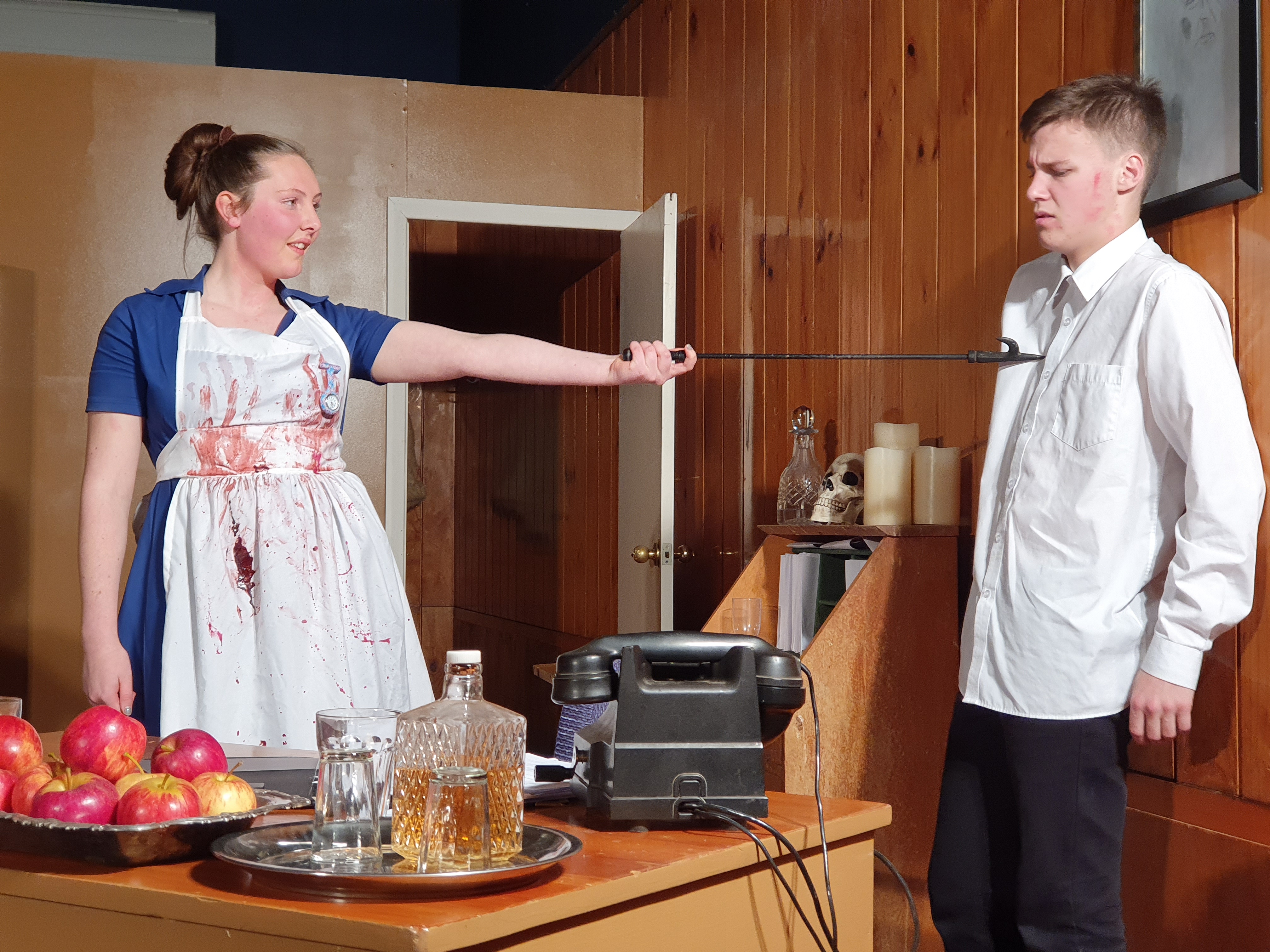
Ruapehu College offers students the opportunity to audition for the bi-annual school production. This is an activity that requires dedication and commitment beyond the classroom in order to produce quality shows. Under the guidance of TIC of Performing Arts, Mr David Sims, the last decade has seen very high calibre performances given including locally penned plays based on events in the Ohakune area.
Year Title & Writer
2016 ‘Mountain Uplift’ an original drama by Kim Basse
2017 ‘Mollie’ an original drama by Kim Basse & David Sims
2018 ‘There’s An App For That?” a comedy farce by Alan Griffith
2019‘ A Tomb With A View’ a murder mystery/black comedy by Norman Robbins
2021 ‘Wheeler’s Luck’ a rural Kiwi comedy by Nigel Collins, Toby Leach and Damon Andrews
2023 ‘The Melody Inside’ an original musical play by David Sims
2025 ‘School Daze’ a collection of dramatic vignettes adapted from the works by Lesley Brown
In the past, a number of our students have been assessed at NCEA Levels 1, 2 and 3 in Drama, including externally moderated 'Excellence' results at each of these levels. Ruapehu College is extremely proud of the reputation earned by our ākonga in the dramatic arts and recognises their commitment to achieving this.
Participating in school productions offers rangatahi a powerful opportunity to grow as learners and individuals. Through the lens of Habits of Mind and Growth Mindset, these experiences foster essential dispositions that support lifelong learning. Students learn to persist through demanding rehearsals, manage impulsivity in high-pressure moments, and listen with empathy as they collaborate across cast and crew.
Productions encourage flexible thinking, creative risk-taking, and a commitment to accuracy and excellence, whether on stage or behind the scenes. Each rehearsal becomes a space for continuous learning, where feedback is embraced and mistakes are reframed as stepping stones to mastery. From audition nerves to opening night triumphs, students develop a growth mindset, discovering that effort leads to improvement and that abilities can be cultivated over time.School productions are more than performances—they're dynamic learning environments where teenagers build confidence, deepen emotional intelligence, and experience the joy of working interdependently toward a shared creative goal.
Smokefree Rockquest 2025, powered by Rockshop, is back and louder than ever! This iconic nationwide music event gives young musicians across Aotearoa the chance to take the stage, perform their own original songs, and soak up the spotlight—from Northland all the way to Southland. It's all about giving youth a platform to express themselves, connect through music, and maybe even take the first step toward a career in the industry.
This year, two of our very own student bands hit the stage at the Whanganui Regional Final on May 17th, held at the Whanganui Royal Opera House. Leon’s Raven, a six-member group, and Bonnie and the Clydes, made up of five talented performers, both bands wowed with heartfelt performances that showed just how much time and talent went into preparing for the big night. Performing in front of a live audience can be pretty daunting, especially on such a grand stage but these students handled it like pros and absolutely smashed it!
A special shout-out goes to Bonnie and the Clydes, who walked away with the Best Song award for their original track “Oh, Honey.” We’re incredibly proud of both bands for representing Ruapehu with style, soul, and serious sound. Keep an eye (and an ear) out—we’ve got some rising stars in our midst!
Dave Sims
TIC Music
Updated April 24, 2026